Showing posts with label External Journey. Show all posts

Sunday, April 19, 2015

My Experience as a Moderator

        Participating in a conference is no easy feat, yet it has been one of the most rewarding up to date. As a public relations and advertising major, I live for communicating. Standing up on a stage and relating with the audience has always been something that I’ve loved. My English professor, Dr. Cynthia Pittmann, gave me the rewarding opportunity to expand my experiences, not only on an academic and professional level, but also on a personal level.
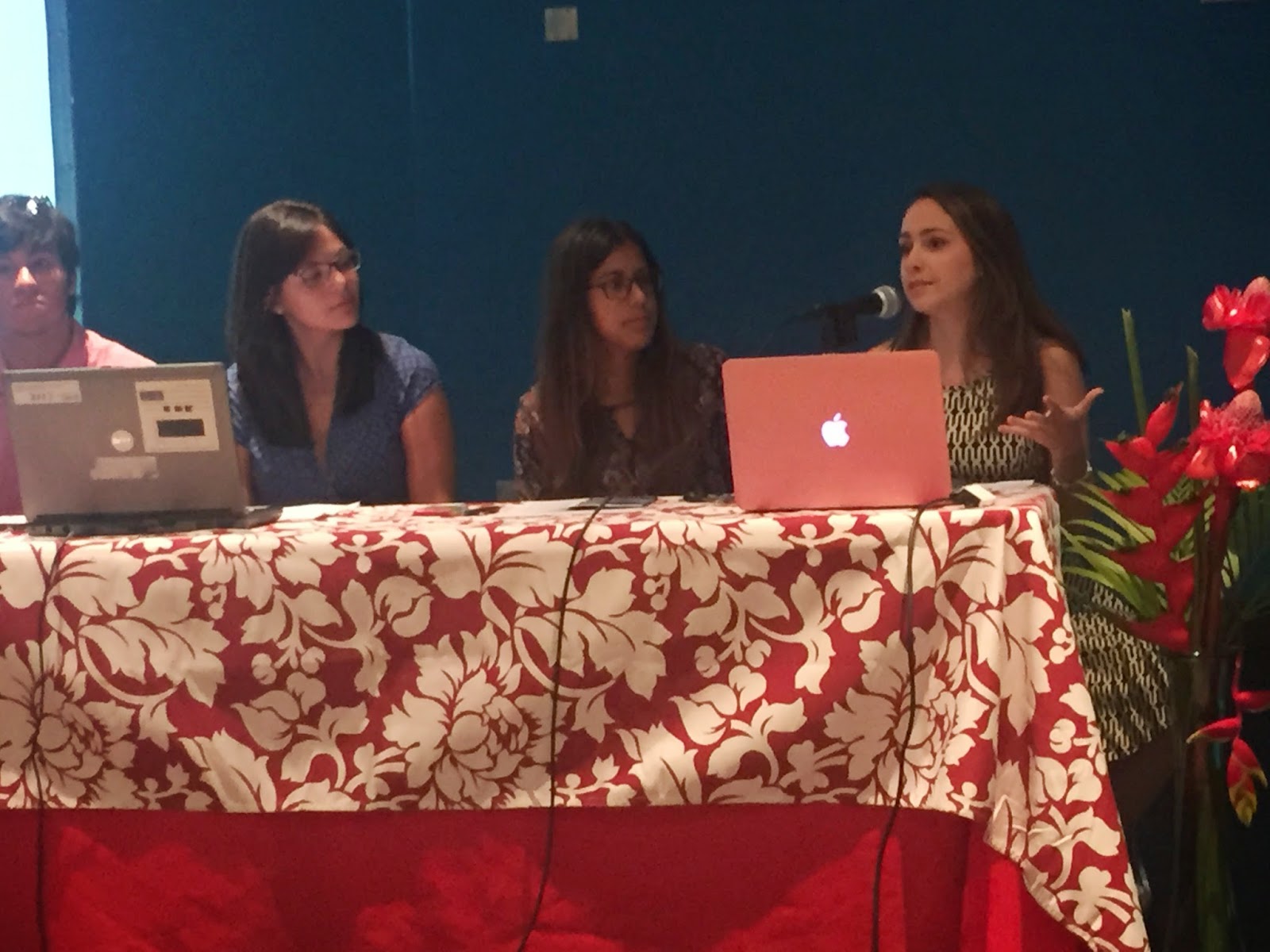
Q&A Section of the panel.
My fellow participants and I (far right).
         Last week the College of General Studies of the University of Puerto Rico, Río Piedras Campus celebrated the 5th Anual Student Research and Writing Conference: Student Collaboration and Contributions Across the Disciplines. My entire class and I had to participate in a panel about Puerto Rican perception online (to read more about this, visit my blog post on the experience by clicking the hyperlink), but only four us had the honor of participating in an extra panel about identity. The panel was titled Interrogating Identity: Home, Language, and Differences. In it, we had the opportunity of reading the essays on identity we had concocted for class. My essay, The Fingerprint of Identity, talked about how language, the notion of home, and history influence our one of a kind identity and it’s expression, behavior. However, not only did I get to read a work of mine, but I also had the opportunity to be the moderator of said panel for which I committedly prepared for in advance. I spent hours obsessing over a Keynote presentation that I’m incredibly proud of, and I also crafted a script for the event.
         Back in high school I was chosen various times to be moderator of various activities, but I had never been given this honor in college. It was a truly rewarding experience. Being moderator thrilled me and made me think that I must be doing something right. For me, a person who is constantly doing the best she can do in all she does, that is a big deal. Usually people would mind the extra work that came with the job, but I didn’t mind it all. At the risk of sounding like a workaholic, I can honestly say I enjoyed doing the work. Additionally, now, looking back on the experience, I’m grateful for the work, not because I liked doing, but because of the way I felt on stage.
        Being on stage gave me valuable experience for the major I’m specializing in, public relations, and the career I wish to pursue, law—two professions where being a dynamic, outspoken person is everything. Additionally, being in charge of that panel made me confident of my skills, something I seldom believe in. I know my skills, but I doubt them often because of the kind of person I am: an over thinker. When on stage, I like the person I am, a confident one that feels proud of herself and like she can do anything. 

        I put great amounts of effort into the panel, but what I got out of it was so much more rewarding. I grew academically and professionally, but more importantly, I grew as a person; that’s the best we can hope for: to grow from our experiences. After all, as this blog suggests, we are a collection of moments we’ve experienced.

Sunday, April 12, 2015

About Journal Writing: Finding Perfection in Imperfection

          Often do you see in movies the use of journals; the mother dies and leaves her children her journal as a piece of her essence so she may always remain alive. Many may roll their eyes at such movie clichés, but I’ve always found it mesmerizing. I’ve always possessed the desire to leave something behind—leave a part of my essence to remain in this world long after I’ve parted it. Journal’s carry this promise; they carry the certainty that you’re life left something—even if they were just words on paper.  Journals vow that you will be remembered in a forgetful and passing world.

I confess; I do not keep a journal. Many times I have tried to pick up the habit, but, ironically, life always seems to get in the way. Something’s always has got to give. Responsibilities steal great amounts of time from our lives and often seem more important than writing a couple of thoughts on a piece of paper. This semester, however, one of my classes (the very one this blog is dedicated to), incorporated journal writing into my responsibilities. It turns out that a push was all I needed to jump-start my journal writing.

However, this journal was not the traditional sort often depicted in films. It contained a specific set of rules (more accurately: “anti-rules”) specifically designed to improve the creative writing process. Taken from Natalie Goldberg’s Writing Down the Bones, the anti-rules were the following:
1.     Don’t cross out.
2.     Don’t worry about spelling, punctuation or grammar.
3.     Don’t think. Don’t get logical.
4.     Go for the jugular.
5.     Keep your hand moving.

Image retrieved from:
https://s-media-cache-ak0.pinimg.com/736x/07/5f/ac/075facc81359581444d3f6ddae36f373.jpg
Following the rules seemed fairly straightforward and easy at first and, for the most part, they were, with the exception of two rules. During most of my journal writing, I had a particularly hard time minding the anti-rules of not worrying about grammar and punctuation as well as not thinking or getting logical. These rules were the ones that most challenged my disposition towards perfection. Some days they were easier to follow, but other days they presented themselves as obstacles I needed to overcome.  This made me realize that my internal journey was greatly influenced by my logical and organized side. Our writing is the reflection of our internal and external journeys. Writing forty-six journal entries under rules that challenge the very nature of perfection helped me learn that my journey, and therefore my writing, is defined by my search for perfection.


Every single entry written challenged me in more than the intended way of helping my creative writing. Of course this part benefited from my journal writing since now I’m able to write more creatively, but the bigger feat of my semester’s companion consisted of schooling me in the art of acceptance. I write more freely now. My vocabulary and style are more relaxed, but they still maintain the order and structure needed; I have started on the path of acquiring the best of both worlds. Thanks to my journal, I can now look past writing perfectly, and towards writing something meaningful; that is, in itself, perfection.