Showing posts with label home. Show all posts

Sunday, April 19, 2015

My Experience as a Moderator

        Participating in a conference is no easy feat, yet it has been one of the most rewarding up to date. As a public relations and advertising major, I live for communicating. Standing up on a stage and relating with the audience has always been something that I’ve loved. My English professor, Dr. Cynthia Pittmann, gave me the rewarding opportunity to expand my experiences, not only on an academic and professional level, but also on a personal level.
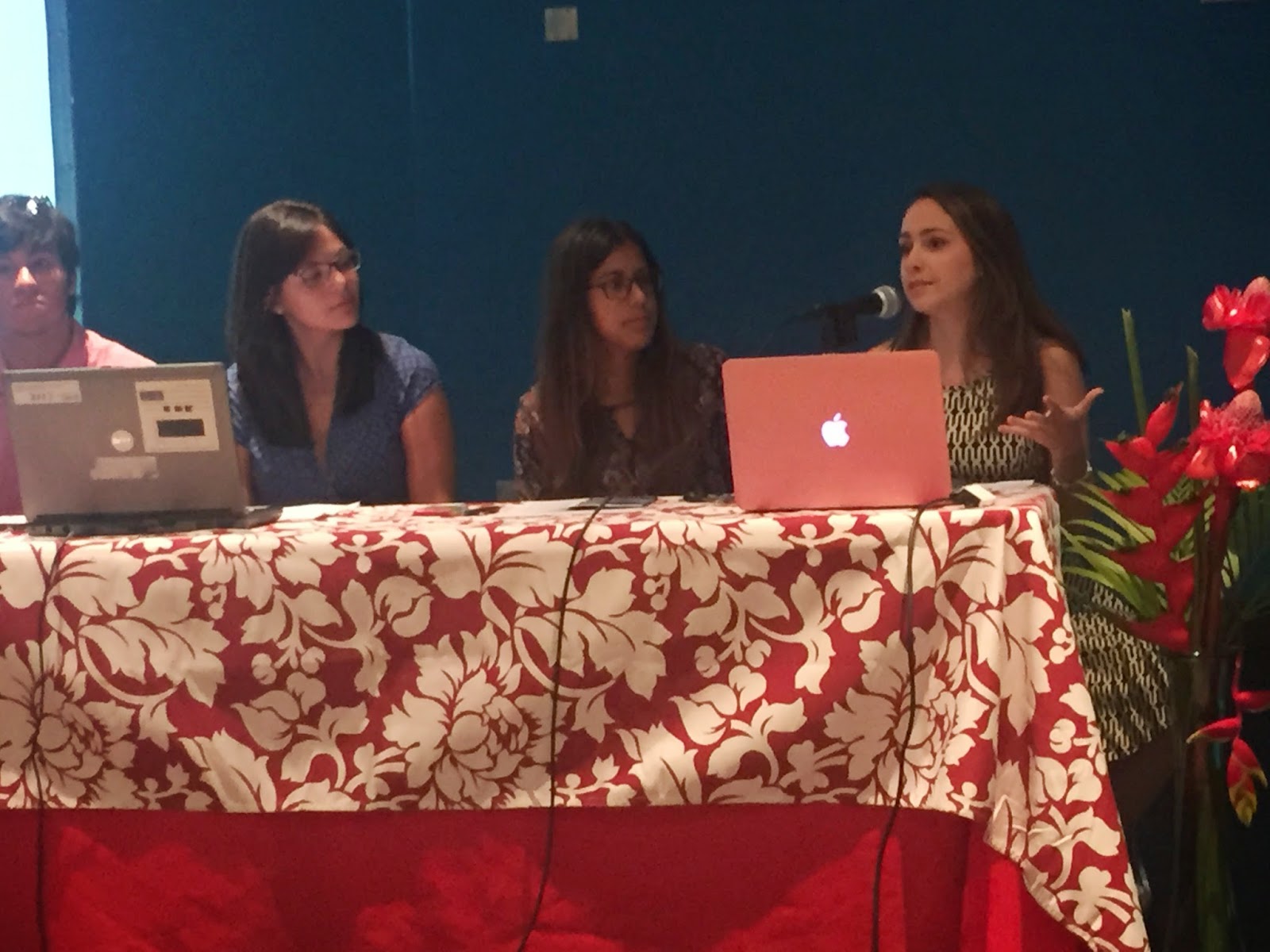
Q&A Section of the panel.
My fellow participants and I (far right).
         Last week the College of General Studies of the University of Puerto Rico, Río Piedras Campus celebrated the 5th Anual Student Research and Writing Conference: Student Collaboration and Contributions Across the Disciplines. My entire class and I had to participate in a panel about Puerto Rican perception online (to read more about this, visit my blog post on the experience by clicking the hyperlink), but only four us had the honor of participating in an extra panel about identity. The panel was titled Interrogating Identity: Home, Language, and Differences. In it, we had the opportunity of reading the essays on identity we had concocted for class. My essay, The Fingerprint of Identity, talked about how language, the notion of home, and history influence our one of a kind identity and it’s expression, behavior. However, not only did I get to read a work of mine, but I also had the opportunity to be the moderator of said panel for which I committedly prepared for in advance. I spent hours obsessing over a Keynote presentation that I’m incredibly proud of, and I also crafted a script for the event.
         Back in high school I was chosen various times to be moderator of various activities, but I had never been given this honor in college. It was a truly rewarding experience. Being moderator thrilled me and made me think that I must be doing something right. For me, a person who is constantly doing the best she can do in all she does, that is a big deal. Usually people would mind the extra work that came with the job, but I didn’t mind it all. At the risk of sounding like a workaholic, I can honestly say I enjoyed doing the work. Additionally, now, looking back on the experience, I’m grateful for the work, not because I liked doing, but because of the way I felt on stage.
        Being on stage gave me valuable experience for the major I’m specializing in, public relations, and the career I wish to pursue, law—two professions where being a dynamic, outspoken person is everything. Additionally, being in charge of that panel made me confident of my skills, something I seldom believe in. I know my skills, but I doubt them often because of the kind of person I am: an over thinker. When on stage, I like the person I am, a confident one that feels proud of herself and like she can do anything. 

        I put great amounts of effort into the panel, but what I got out of it was so much more rewarding. I grew academically and professionally, but more importantly, I grew as a person; that’s the best we can hope for: to grow from our experiences. After all, as this blog suggests, we are a collection of moments we’ve experienced.

Sunday, March 1, 2015

The Fingerprint of Identity


Image retrieved from:
http://meetville.com/images/quotes/Quotation-Dorothy-
West-identity-Meetville-Quotes-5275.jpg
  Gabriel García Márquez, one of the most revered authors in the Spanish language, once wrote:  “He allowed himself to be swayed by his conviction that human beings are not born once and for all on the day their mothers give birth to them, but that life obliges them over and over again to give birth to themselves”. Human beings are always evolving; that’s the very purpose of life. When we are born, we are not born whole—we aren’t born being who we are, we become whole by the experiences, people, and moments we come across throughout the course of our lives. Therefore, our identity—who we are—is intrinsically tied and influenced by our notion of home, language, history, and behavior.
The notion of home is, in itself, an extremely open concept. It—or rather what determines home—is not the same for everyone. Peter Roberts attributes this to the fact that “home embodies a psychological factor of attachment”. Home is, indeed, a psychological and emotional factor. Our place of birth or place of residence doesn’t categorically decide our notion of home or identity. However, since home is a feeling, they can have some influence over them, but not categorically decide them. Home is feeling good, secure, happy, and like you belong. Countless things that are entirely up to the person in question at a given period of time can determine these feelings. Additionally, “the human being does not necessarily remain in one place throughout a lifetime” (Roberts). By “remaining in one place”, Roberts refers to remaining as an emotional being. We are constantly changing and evolving; we are not static beings in any sense (physically and mentally). Since home is determined by our feelings and emotions and these, in turn, are two continuously changing things, the notion of home is also ever-changing.
Image retrieved from:
http://favim.com/orig/201104/25/Favim.com-23850.jpg
            Language as well as the notion of home is tied to the concept of place. A language is subject to a specific place—or places. This, in turn, also establishes the sense of the “other”[1]. Roberts describes this factor by stating: “language therefore establishes bonds between all communities of human beings but at the same time sets up barriers between communities”. However, when it pertains to identity, language, like the notion of home and although in lesser degree, can also be subject to psychological factors. Our language is generally the one of our place of birth or residence. Nonetheless, our language can also be determined based on a psychological attachment to a language that has developed from certain emotional reasons. For example, you may have been born and resided all your life in the United States where English is the spoken language, but your family is of Puerto Rican origin—a place where Spanish is spoken, and you feel more attached to Spanish than to English. You have developed a psychological attachment to Spanish and assume it as your own even if you have grown up in an English speaking country. Therefore, Spanish is the language that will come to identify you. Nevertheless, this phenomenon happens in lesser degree since acquiring languages is trickier than simply developing a notion of what “home” means to you.
            History also has direct impact over people’s identities. Our place of birth and residency’s history affects the identity of its people. A country’s history shapes the countries culture as well as the minds of its population. Every country comes with its own beliefs that directly influence that country’s historical background. For example, Antigua is an island in the Caribbean that was colonized by the English during the Colonial Era. Jamaica Kincaid, a renowned author from Antigua, directs the following words towards the English:
Do you know why people like me are shy about being capitalists? Well, it's because we, for as long as we have known you, were capital, like bales of cotton and sacks of sugar, and you were the commanding, cruel capitalists, and the memory of this is so strong, the experience so recent, that we can't quite bring ourselves to embrace this idea that you think so much of. As for what we were like before we met you, I no longer care.
Through Kincaid’s words, we are able to notice how the historical relationship between England and Antigua influenced her identity. She doesn’t consider herself a capitalist because of her experience with capitalist people. Being a capitalist is not something that’s part of her identity because the history of her birthplace influenced her to perceive capitalism as something bad and, therefore, affected her political identity. Furthermore, Kincaid also states: “Have I given you the impression that the Antigua I grew up in revolved almost completely around England? Well, that was so. I met the world through England, and if the world wanted to meet me it would have to do so through England”. Kincaid openly states the degree of influence England’s presence in Antigua had over her persona. She acknowledges that her country was completely altered by England, and, because of that, her identity was dependent of that relationship.
Moreover, behavior is the thing that influences a person’s identity the most. Roberts defines the concept to encompass “a wide array including supernatural practices, entertainment, sports and games, and educational practices”. He judges it as merely a “category in judgments of identity” (Roberts). However, behavior is the one thing that encompasses it all. It can even be stated that behavior can very well be a synonym of identity. Behavior is defined by our sense of home, our language, our beliefs, and all the countless things that determine our identity because it is our identity. More specifically, behavior is the expression of identity. Identity is the abstract and fleeting concept of the thing itself: who you are. Meanwhile, behavior is the thing by which the abstract (identity) turns into something concrete.
Image retrieved from:
http://4.bp.blogspot.com/-sM7xxxEmcSo/T18qeNEM1gI/AAAAAAAAAG8
/NcHFm5Vleqs/s640/identityedit7small.jpg
            Identity is a wide, abstract, and fleeting concept that expresses itself through behavior. Many things determine our identity; our notion of home, language, historical influences, and behavior are only a few. The notion of home is not a constant concept that isn’t categorically determined by birthplace or residence because it’s based on feelings of security, belonging, and happiness. Therefore it is a concept that can change multiple times throughout a person’s life. A person’s language is tied, but not limited to the concept of place. Not only are languages determined based on the geographical area where they are spoken, but also by psychological attachments. Moreover, a countries history affects the identity of its people since it directly affects the country’s culture and beliefs. Behavior is, however, the most important component of a person’s identity because it is its expression. A person’s identity—an abstract concept—manifests itself into a concrete thing through behavior. Many of the things that determine our identity are psychological factors because identity is not determined by cold hard facts, but rather individually, by the person in question—a person that can and is subject to all kinds of bias. However, that is precisely the beauty of identity: like a fingerprint, there are no two alike.


Works Cited
Kincaid, Jamaica. A Small Place. 1989.
Márquez, Gabriel García. Quotes About Identity. 2015. Goodreads, Inc. 2015 February 2015 <http://www.goodreads.com/quotes/tag/identity>.
            Roberts, Peter. The Roots of Caribbean Identity: Language, Race, and Ecology. New York: Cambridge U.P., 2008. 1-5.


[1] “Other”: Word that comes from the term “othering”; when it’s identified that there is a difference between two people and a barrier is created product of the lack of sameness.