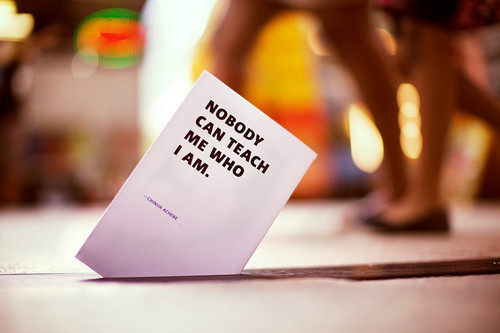
Sunday, April 12, 2015

About Journal Writing: Finding Perfection in Imperfection

          Often do you see in movies the use of journals; the mother dies and leaves her children her journal as a piece of her essence so she may always remain alive. Many may roll their eyes at such movie clichés, but I’ve always found it mesmerizing. I’ve always possessed the desire to leave something behind—leave a part of my essence to remain in this world long after I’ve parted it. Journal’s carry this promise; they carry the certainty that you’re life left something—even if they were just words on paper.  Journals vow that you will be remembered in a forgetful and passing world.

I confess; I do not keep a journal. Many times I have tried to pick up the habit, but, ironically, life always seems to get in the way. Something’s always has got to give. Responsibilities steal great amounts of time from our lives and often seem more important than writing a couple of thoughts on a piece of paper. This semester, however, one of my classes (the very one this blog is dedicated to), incorporated journal writing into my responsibilities. It turns out that a push was all I needed to jump-start my journal writing.

However, this journal was not the traditional sort often depicted in films. It contained a specific set of rules (more accurately: “anti-rules”) specifically designed to improve the creative writing process. Taken from Natalie Goldberg’s Writing Down the Bones, the anti-rules were the following:
1.     Don’t cross out.
2.     Don’t worry about spelling, punctuation or grammar.
3.     Don’t think. Don’t get logical.
4.     Go for the jugular.
5.     Keep your hand moving.

Image retrieved from:
https://s-media-cache-ak0.pinimg.com/736x/07/5f/ac/075facc81359581444d3f6ddae36f373.jpg
Following the rules seemed fairly straightforward and easy at first and, for the most part, they were, with the exception of two rules. During most of my journal writing, I had a particularly hard time minding the anti-rules of not worrying about grammar and punctuation as well as not thinking or getting logical. These rules were the ones that most challenged my disposition towards perfection. Some days they were easier to follow, but other days they presented themselves as obstacles I needed to overcome.  This made me realize that my internal journey was greatly influenced by my logical and organized side. Our writing is the reflection of our internal and external journeys. Writing forty-six journal entries under rules that challenge the very nature of perfection helped me learn that my journey, and therefore my writing, is defined by my search for perfection.


Every single entry written challenged me in more than the intended way of helping my creative writing. Of course this part benefited from my journal writing since now I’m able to write more creatively, but the bigger feat of my semester’s companion consisted of schooling me in the art of acceptance. I write more freely now. My vocabulary and style are more relaxed, but they still maintain the order and structure needed; I have started on the path of acquiring the best of both worlds. Thanks to my journal, I can now look past writing perfectly, and towards writing something meaningful; that is, in itself, perfection.

Sunday, March 15, 2015

Jim Cooper: On Teaching a Language

           
University of Puerto Rico, Mayagüez Campus seal
Image retreived from:
http://upload.wikimedia.org/wikipedia/en/thumb/6/65/UPR
_at_Mayaguez_Seal.svg/1024px-UPR_at_Mayaguez_Seal.svg.png


          Jim Cooper in his memoir, Down on the Island, remembers when, during his time as an English professor at the University of Puerto Rico, Mayagüez Campus,  a co-worker of his said expressed how “(…) the only way to learn a language was to learn to love its literature”. Although it may not seem that way, that is a complex statement to make. When I first read it, I could not understand the tone of disbelief with which Jim Cooper portrayed his memory. After pausing for a few seconds and re-reading the statement a few times, I finally understood the statements complexity.

Down on the Island by Jim Cooper
(Book cover)
            The memoir published in 1994 recounts the 1951-1954 period of the author’s life where he taught English in a place where said language was not the official one and, most of the time, barely understood by its people. Puerto Rico, as I discussed in one of my previous posts, is, presently, a Commonwealth of the United States of America (USA) and, because of it, most people here know English as a second language. However, this wasn’t always this way. Since the acquisition of Puerto Rico by the United States back in 1898, English had tried to be enforced as a primary language on the island, but the idea never really clicked with islanders. Therefore, in 1952, when the political relationship between the USA and Puerto Rico became what it is now, English was still not a language most people were fluent in, but rather one that only the most privileged people knew how to speak. With this in mind, the complexity of the mentioned statement becomes a bit clearer.

            I’ve lived in Puerto Rico and known these facts my whole life, but I’ve also grown up in a different time and, therefore, a different Puerto Rico than the one described in the book. Presently, English in Puerto Rico is practically a second first language. Although many people are still not fluent in the language, much more citizens are. Additionally, I’ve also grown up surrounded in equal proportions with both languages making both English and Spanish first languages for me. This is why, at first, the author’s disbelief puzzled me. When we are so immersed by a language, our perspective of things is influenced by that, and, to see the bigger picture, you have to step out of your land, and see a birds-eye-view of the world.

***


Books are teachers.
Image retrieved from:
https://s-media-cache-ak0.pinimg.com/originals/8b/d3/06/8bd30643917b9
e6000f6e9a5184e9c14.jpg
            “(…) the only way to learn a language was to learn to love its literature”. This is certainly true. We learn something because we love and/ or appreciate it. Therefore, how can you appreciate a language’s beauty to then want to learn it if you do not know the fruits of that language? Literature is the expression of language, and language is the tool by which we express our humanity. The beauty of language is in its utility: expression and communication. Therefore, without comprehending language’s utility, loving it would be impossible because we would find it useless, and humans need usefulness to love.
***
            “(…) the only way to learn a language was to learn to love its literature”. How can you appreciate the literature if you do not know the language? Touché. Someone may argue that it’s possible to find a translation of a work of literature and still be able to appreciate the language through literature. Nevertheless, it wouldn’t represent the original language in any way since it isn't being read in said language. If anything, a translated work only represents the author that wrote it. The tool was changed from a hammer to a screw-driver—from English to Spanish. You can’t appreciate a hammer through the use of a screw-driver. You can’t learn to love a language’s literature to then learn the language itself because reading the literature would result impossible.

***
            There is no categorical explanation to what is actually the thing that will motivate students to learn English. Consequently, there will not be a categorical way of teaching language. Some may want to learn a language because they’ve fallen in love with stories read in a different language that have peaked their interest. Others may learn a language without falling in love with its literature first.  In the end, teaching will be subject to each individual’s reason towards learning the language as well as their personality.

            What came first: the chicken or the egg? It depends.

A Small Place: How My Small Place Influenced My Reading of Kincaid

     
From left to right:
Sabrina; Natalia; Bárbara (me); Bianca
        Like a normal college student, I spend a portion of my time on campus hanging out with my friends. My best friends and I call each other The Girls. We’re four girls that are best friends and have known each other since high school; however, since we started university, we have become much closer. A few weeks ago, I was talking with one of them—Natalia—about Jamaica Kincaid. It had coincidently turned out that her English professor assigned her Jamaica Kincaid’s novel, A Small Place, as one of the class’ readings, just like my profesor had.

First off, let me tell you a little bit about Natalia. She’s a very outspoken and authentic person. She is sarcastic, honest, and an avid reader. In many ways, she is a lot like Jamaica Kincaid. It is no surprise then, that when I asked her if she liked the reading her eyes lit up, she took out the book, and engaged in an enthusiastic monologue about her newly found love towards Jamaica Kincaid. I listened to her, and while she proclaimed her admiration towards this new author she’d discovered, I couldn’t help but wonder why I didn’t feel as enthusiastic about the reading as she did. After thinking about this fact for some time, I arrived at the conclusion that it wasn’t a matter of Kincaid being a good writer or not and much less about the quality of the novel itself. For me, my lack of enthusiasm ran much deeper: my own families history. 

A Small Place by Jamaica Kincaid book cover.
Image retrieved from:
http://www.mpalacioart.com/wp-content/uploads/2015/02/small-place.jpg
A Small Place, by Jamaica Kincaid, explores the topic of how the presence of the English (i.e. Great Britain) in Antigua during colonial times affected the island’s economic, social, political, and cultural present. Jamaica Kincaid is a very sassy and sarcastic author. Therefore, she exposes her themes in the same tone. Additionally, every line you read, although completely justified, comes with a hint of anger towards the colonizer. This aspect hit home. 

I was born and raised in San Juan, Puerto Rico to a Puerto Rican father and Cuban mother. I spent little time with my father’s family, while most was spent with my Cuban grandparents. This made me grow up with a great love and respect towards Cuba, more so than the love I feel for Puerto Rico (although I respect and love both). Most words I use are used in Cuba and not in Puerto Rico. I strongly dislike Puerto Rican food yet absolutely adore Cuban food. In essence, most of the aspects that make up my identity are Cuban. My mother’s family are Cuban exiles that left the island after Fidel Castro rose to power. The amount of horrifying stories that have been told to me about the limitation of rights after he became president of the island would shock you to your very core. To name one of the most mild and insignificant examples, when my grandparents were leaving the island in 1968, my grandmother, being the religious woman that she is, tried to take with her an image of the patron saint of Cuba, la Virgen de la Caridad del Cobre, that had sentimental value. You were only allowed to leave the island with the clothes you had on your back and a small suitcase so when they found she was hiding the image under all her clothing, they took it away from her. What harm to the Republic could a religious image do? My grandmother, up to this day, continues to wonder this. 

With this poignant influence ever-present in my life, when someone condemns the hand that gave them progress, my blood boils. Kincaid exposes many arguments. For example, she criticizes the English for edifying universities in Antigua because the education they provided was biased towards their [English] culture. All her arguments, including the one mentioned here, are evident truths. Yes, the education provided by the universities Great Britain built in Antigua was from an English perspective. Nevertheless, her angry tone towards the English doesn’t make me relate to her writing. My Cuban background doesn’t let me appreciate it. Coming from a family who involuntarily had to leave their country in search for a new life, I can't understand why Kincaid is not able to acknowledge that the English did give Antigua good things. She doesn’t have to like it and much less agree with it. I simply believe she should also expose the bright side. At least they have universities because of the English--biased or not.

Jamaica Kincaid
Image retrieved from:
https://lchenn3.files.wordpress.com/2013/10/kincaid-jamaica-c-kenneth-noland_
custom-f53d866b80a4ceb1225fc3745686bc0cdae02ae8-s6-c30.jpg
        Coming from a background of two Caribbean islands, I know what it’s like to live in a colonized place. I’ve seen the horrors colonization has brought, but I’ve never agreed with the complete antagonizing of it either. Colonization did bring many horrors, but it also brought progress to many Caribbean islands. Therefore, to me it seems unjust to present just one version of it. For the complete picture, we must present both sides of the story: the positive and the negative. As I’ve said, all of Kincaid's arguments are true. It is the way she states  them—with hatred—as well as the fact that she fails to see the bright side that doesn’t make me click with her. Nonetheless, it seems like Kincaid and I are more alike than I thought: both our Caribbean blood boils for what we believe; a belief strongly influenced by our roots.

Wednesday, March 11, 2015

Jim Cooper is "O Captain, my Captain": Making a Difference

              “O Captain, my Captain!”. Originally from a Walt Whitman poem, the phrase is also one of the most famous quotes in film history. Robin Williams’ character, John Keating, in the 1989 film Dead Poets Society assumes the role of a professor with unconventional thoughts and teaching methods that tries to inspire his student love poetry and to live vicariously. Jim Cooper’s reading, Downon the Island, supports the ideas presented in this film and countless others (e.g. Freedom Writers); educators have, without a doubt, an enormous impact on their student’s journeys.
Down on the Island by Jim Cooper
(Book cover)
            Down on the Island, at first glance, is a memoir of Jim Cooper’s life during the period of 1951-1954 when he lived and taught English on the island. However, the more interesting subject, although briefly referred to in the reading, recounts how students, on the last day of class would give their professors presents. He specifically states: “The presents were not, of course given because you gave them passing grades, but to thank you for teaching them something”. As a current college student, I can tell you that having a professor that makes you see things in a different light, challenges you yet doesn’t beat you down, and has faith and encourages you is one of the best feelings in the world. Nowadays, we live in a world where the thirst for knowledge in the traditional sense (lectures; homework; test; papers) is slowly dying. Additionally, no matter in what period of time, there will be individuals who abhor studying in the traditional sense. Furthermore, knowledge is the key to a functioning, good society. This is why gifted educators are so important in the lives of their students. Professors have the power to open new doors of thought and opportunity for their students, consequently affecting the course of their internal and external journey.
            I don’t seek to be an educator; it’s not my calling, but I do wish to be able to leave my mark in this world. I want my life to mean something. I’m ambitious, and I want to be great, but I want to be great by helping and leaving something positive behind. When I die, I want to leave behind a memory that says that I fought, I conquered, and made a difference somewhere in the world —left a mark on someone.

Bárbara Aponte (left); Mrs. Cynthia Pujals (right)
High School Graduation (2 years ago).
            We have all been students at one point in our lives, and almost everyone has that one professor that’s really made an impact in their lives. Those professors are the ones that are represented in the countless inspirational films; one of those professors is Jim Cooper. They are the ones that influence society greatly and go down in quiet history. I admire educators because of these very reasons, but the importance of their job often goes unnoticed. Therefore, readers, if any of you has the gift of being or preparing to be an educator, I congratulate and thank you from the bottom of my heart. I send a special shout-out to the professor that has influenced my journey the most, my tenth grade English teacher, Mrs. Cynthia Pujals. Thank you for always listening.

Saturday, March 7, 2015

How travel can alter our lives forever: A Room with a View (1985)

          The 1985 film, A Room with a View is based on E.M. Forster’s novel of the same name. If you look for a synopsis of the movie online or ask for one to anyone who’s seen the movie , you’ll probably be told that it’s a story about a young man and woman who fall in love while vacationing in Florence and how they altered each other’s lives forever. However, A Room with a View, is so much more than that. Through a beautiful love story, the film shows us how traveling can forever alter our lives in unexpected ways.
      Travel and a simple room with a view--that’s all it took for a love story to embark. Lucy Honeychurch, a well-bread English lady, traveled to Florence with her cousin Charlotte Bartlett where she met the love of her life, George Emerson. During her trip, Lucy lived an adventure complete with a world wind romance. Once she returned home, the romance, as well as every other trip event, became a memory. She returned to her old home, and tried to get back to her normal life which entailed her marrying another man, Cecil Vyse. What Lucy soon found out after her return home when, coincidentally, George moved with his father to Lucy’s town, was that her trip had forever changed her in unexpected ways. Her past clashed with her presently changed self and developed a struggle within her that forced her to accept her present self.
 
       One of the film’s characters, a novelist called Eleanor Lavish, describes Lucy as a: “A young girl, transfigured by Italy! And why shouldn't she be transfigured?”. Some will say love was the force that transfigured her and, to an extent, that is correct. Nevertheless, I say Florence and travel were the primary things that changed her life forever. In Florence, she met George, let go of her inhibitions, and, most importantly, fell in love. She fell in love while she was a tourist. She fell in love because she was a tourist. When one travels, one feels content and at peace. These feelings, in turn, permit you to open up to new experiences because, ultimately, this is what is searched for when one travels.  Travel opened her up to love and permitted her to fall into it. Florence and traveling were the ultimate wingmen.

When we travel: we change in unexpected ways. We come back expecting to go back to our old lives, but it results impossible because, even if it may not be noticeable, we are forever changed just like Mrs. Lucy. Therefore, travel as much as you can because one way or another you will be changed. 

Sunday, March 1, 2015

The Fingerprint of Identity


Image retrieved from:
http://meetville.com/images/quotes/Quotation-Dorothy-
West-identity-Meetville-Quotes-5275.jpg
  Gabriel García Márquez, one of the most revered authors in the Spanish language, once wrote:  “He allowed himself to be swayed by his conviction that human beings are not born once and for all on the day their mothers give birth to them, but that life obliges them over and over again to give birth to themselves”. Human beings are always evolving; that’s the very purpose of life. When we are born, we are not born whole—we aren’t born being who we are, we become whole by the experiences, people, and moments we come across throughout the course of our lives. Therefore, our identity—who we are—is intrinsically tied and influenced by our notion of home, language, history, and behavior.
The notion of home is, in itself, an extremely open concept. It—or rather what determines home—is not the same for everyone. Peter Roberts attributes this to the fact that “home embodies a psychological factor of attachment”. Home is, indeed, a psychological and emotional factor. Our place of birth or place of residence doesn’t categorically decide our notion of home or identity. However, since home is a feeling, they can have some influence over them, but not categorically decide them. Home is feeling good, secure, happy, and like you belong. Countless things that are entirely up to the person in question at a given period of time can determine these feelings. Additionally, “the human being does not necessarily remain in one place throughout a lifetime” (Roberts). By “remaining in one place”, Roberts refers to remaining as an emotional being. We are constantly changing and evolving; we are not static beings in any sense (physically and mentally). Since home is determined by our feelings and emotions and these, in turn, are two continuously changing things, the notion of home is also ever-changing.
Image retrieved from:
http://favim.com/orig/201104/25/Favim.com-23850.jpg
            Language as well as the notion of home is tied to the concept of place. A language is subject to a specific place—or places. This, in turn, also establishes the sense of the “other”[1]. Roberts describes this factor by stating: “language therefore establishes bonds between all communities of human beings but at the same time sets up barriers between communities”. However, when it pertains to identity, language, like the notion of home and although in lesser degree, can also be subject to psychological factors. Our language is generally the one of our place of birth or residence. Nonetheless, our language can also be determined based on a psychological attachment to a language that has developed from certain emotional reasons. For example, you may have been born and resided all your life in the United States where English is the spoken language, but your family is of Puerto Rican origin—a place where Spanish is spoken, and you feel more attached to Spanish than to English. You have developed a psychological attachment to Spanish and assume it as your own even if you have grown up in an English speaking country. Therefore, Spanish is the language that will come to identify you. Nevertheless, this phenomenon happens in lesser degree since acquiring languages is trickier than simply developing a notion of what “home” means to you.
            History also has direct impact over people’s identities. Our place of birth and residency’s history affects the identity of its people. A country’s history shapes the countries culture as well as the minds of its population. Every country comes with its own beliefs that directly influence that country’s historical background. For example, Antigua is an island in the Caribbean that was colonized by the English during the Colonial Era. Jamaica Kincaid, a renowned author from Antigua, directs the following words towards the English:
Do you know why people like me are shy about being capitalists? Well, it's because we, for as long as we have known you, were capital, like bales of cotton and sacks of sugar, and you were the commanding, cruel capitalists, and the memory of this is so strong, the experience so recent, that we can't quite bring ourselves to embrace this idea that you think so much of. As for what we were like before we met you, I no longer care.
Through Kincaid’s words, we are able to notice how the historical relationship between England and Antigua influenced her identity. She doesn’t consider herself a capitalist because of her experience with capitalist people. Being a capitalist is not something that’s part of her identity because the history of her birthplace influenced her to perceive capitalism as something bad and, therefore, affected her political identity. Furthermore, Kincaid also states: “Have I given you the impression that the Antigua I grew up in revolved almost completely around England? Well, that was so. I met the world through England, and if the world wanted to meet me it would have to do so through England”. Kincaid openly states the degree of influence England’s presence in Antigua had over her persona. She acknowledges that her country was completely altered by England, and, because of that, her identity was dependent of that relationship.
Moreover, behavior is the thing that influences a person’s identity the most. Roberts defines the concept to encompass “a wide array including supernatural practices, entertainment, sports and games, and educational practices”. He judges it as merely a “category in judgments of identity” (Roberts). However, behavior is the one thing that encompasses it all. It can even be stated that behavior can very well be a synonym of identity. Behavior is defined by our sense of home, our language, our beliefs, and all the countless things that determine our identity because it is our identity. More specifically, behavior is the expression of identity. Identity is the abstract and fleeting concept of the thing itself: who you are. Meanwhile, behavior is the thing by which the abstract (identity) turns into something concrete.
Image retrieved from:
http://4.bp.blogspot.com/-sM7xxxEmcSo/T18qeNEM1gI/AAAAAAAAAG8
/NcHFm5Vleqs/s640/identityedit7small.jpg
            Identity is a wide, abstract, and fleeting concept that expresses itself through behavior. Many things determine our identity; our notion of home, language, historical influences, and behavior are only a few. The notion of home is not a constant concept that isn’t categorically determined by birthplace or residence because it’s based on feelings of security, belonging, and happiness. Therefore it is a concept that can change multiple times throughout a person’s life. A person’s language is tied, but not limited to the concept of place. Not only are languages determined based on the geographical area where they are spoken, but also by psychological attachments. Moreover, a countries history affects the identity of its people since it directly affects the country’s culture and beliefs. Behavior is, however, the most important component of a person’s identity because it is its expression. A person’s identity—an abstract concept—manifests itself into a concrete thing through behavior. Many of the things that determine our identity are psychological factors because identity is not determined by cold hard facts, but rather individually, by the person in question—a person that can and is subject to all kinds of bias. However, that is precisely the beauty of identity: like a fingerprint, there are no two alike.


Works Cited
Kincaid, Jamaica. A Small Place. 1989.
Márquez, Gabriel García. Quotes About Identity. 2015. Goodreads, Inc. 2015 February 2015 <http://www.goodreads.com/quotes/tag/identity>.
            Roberts, Peter. The Roots of Caribbean Identity: Language, Race, and Ecology. New York: Cambridge U.P., 2008. 1-5.


[1] “Other”: Word that comes from the term “othering”; when it’s identified that there is a difference between two people and a barrier is created product of the lack of sameness.